
45 New Year Journal Prompts To Keep You Journaling Past February

New Year journal prompts are everywhere in January, and so are the shiny new notebooks that end up abandoned by the end of February. I know, because I tried to start journaling for a while before it finally became a habit. A fresh start feels amazing right up until real life shows up.
So this post is built very differently. Instead of one giant list, you get prompts grouped by what you need: looking back, letting go, setting intentions, and small check-ins that bring you back to the page. Pick a few, skip the rest, and start with one line.

Starting the year with a fresh journal is one of my favorite rituals. There is something special about a blank page that hasn’t been filled with anything yet.
But I’ve been journaling in one format or another since I was a kid, and I finally got consistent only in 2018. So I’ve learned that the first page is never the problem. The problem is page thirty: it’s Tuesday, you’re tired, and the journal starts to feel like homework.
That’s why this post has new year journal ideas and also a few ways to keep going once the excitement fades. You’ll find prompts for every kind of day, including the ones when you can barely manage a sentence.
This post may contain affiliate links. They will be of no extra expense for you, but I receive a small credit. Please see my Disclosure for more details. Thank you for supporting Masha Plans!
Why New Year Journals Fizzle Out By February
Before the prompts, let’s look at why most New Year journals don’t make it. It usually comes down to one of these four things, and each one has an easy fix.
- You start too big.
Writing three pages on January 1st feels great, but it sets a bar you can’t keep up. Decide on your minimum before you begin. Make it one line, and treat anything above that as a bonus.
- A missed day feels like failure.
One missed day turns into three, and then the journal is sitting on a shelf, making you feel guilty. Make yourself a restart rule: no catching up and no apologizing to the page. Just write today’s date and keep going.
- The prompts are all about the future.
“Who do I want to become?” is a heavy question to answer every morning. Mix looking back and small, present-moment prompts in with the bigger ones.
- There’s no reason to come back.
A journal needs a few built-in return points. A check-in on the first of each month gives you a natural moment to open it again, and you’ll find prompts for that below.
Knowing where you might run into issues will help you prepare and have a plan for when the day comes and you struggle. These are some of the main bottlenecks I think people encounter, and as you can see, each has an easy trick to keep it from getting in your way.
How To Use These New Year Journal Prompts
Before I share the prompts and you get scared you have to write 45 pages for each one, let me clarify something.
You don’t need to do all 45 prompts. Honestly, please don’t. Here’s a gentle way to use them:
- Pick one or two prompts from each of the first five sections and write through them in the last week of December or the first week of January.
- Keep the “easy days” prompts handy for when motivation drops.
- Use the monthly check-ins on the first of each month, all year long.
Write in whatever way feels right: full paragraphs, bullet points, lists, or doodles. This is your journal, so handwriting and spelling are the last things to worry about.
Okay, you are ready, so here are ALL the prompts to choose from.
Prompts For Looking Back At Last Year
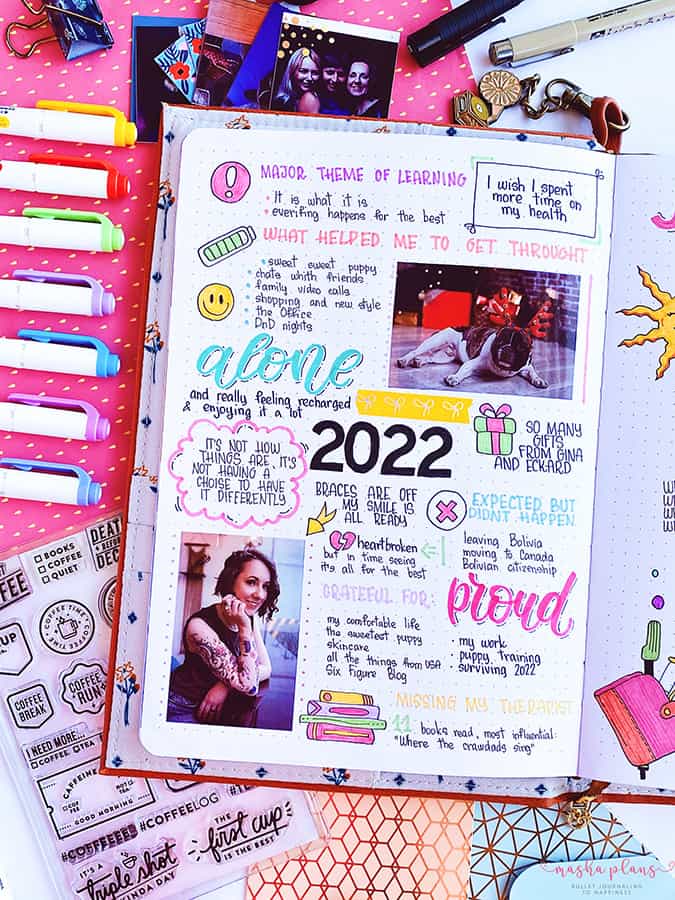
A yearly review is the first step before setting goals, because it’s hard to plan where you’re going without knowing where you’ve been. These prompts are about noticing, not judging.
You can answer them in a list, a spread in your Bullet Journal, or a few honest paragraphs.
- What were three moments from this year I would happily live again?
- What took up most of my energy this year, and was it worth it?
- What did I do this year that I didn’t think I could?
- Which month was the hardest, and what got me through it?
- What did I say yes to that I should have said no to?
- What surprised me most about myself this year?
- If this year had a title, what would it be and why?
Don’t skip the hard months. The prompts you want to avoid often hold the most useful answers.
Prompts For Letting Go And Starting Fresh
A clean slate isn’t only about adding new things. It’s also about deciding what doesn’t come with you into the new year, and that can feel surprisingly good.
- What have I kept doing only out of habit?
- Which commitment drains me more than it gives back?
- What story about myself am I tired of telling?
- What would I stop apologizing for?
- Which expectation, mine or someone else’s, can I put down this year?
You don’t need to fix any of these right now. Just naming them is a great first step.
Intention And Word Of The Year Prompts
New Year’s resolutions tend to be about results, while intentions are about how you want your year to feel. I find that much easier to stick with.
My word for 2025 was “alignment”, and a single word is easy to remember when you’re deciding what to say yes to.
- How do I want to feel most days this year?
- What three words describe the year I’m hoping for?
- If I had to pick one word for the year, what would it be and what does it mean to me?
- What does a good, ordinary Tuesday look like in my ideal year?
- How do I want to show up for the people I love?
- What would I do more of if I stopped worrying about being productive?
- What do I want this year to feel less like?
You can also turn your answers into a word of the year page, a vision board, or just a sentence on the first page of your journal.

Goal Prompts That Fit Real Life
Goals work best when they fit the life you actually have. A big, shiny goal that ignores your busiest weeks usually disappears in February. These prompts will help you shape goals that are realistic and truly yours.
- What’s one goal I would be proud of even if nobody ever knew?
- Which goals am I choosing because I want them, and which because I think I should?
- What’s the smallest version of this goal I could do on my worst week?
- What is most likely to get in my way, and what’s my plan for it?
- What would I need to stop doing to make room for this goal?
- How will I know by June that it’s working?
Two or three goals you actually follow are far better than ten you forget about by March.
Habit And Routine Prompts
Habits are where most New Year plans fall apart, so it helps to understand what happened last time before you try again.
- Which habit did I try last year and drop, and what actually made it hard?
- What’s one habit I already have that I’m proud of?
- At what time of day do I have the most energy for something new?
- What existing routine could I attach a new habit to?
- What would a gentle morning or evening routine look like for me?
If a habit didn’t stick, it probably wasn’t about willpower. It was likely about timing, setup, or trying to do too much at once.
Self-Care And Feelings Prompts
A new year journal isn’t only for goals and plans. It’s also a place to check in with yourself. These prompts are gentler and work well in the evening or on slower days.
- What does rest actually look like for me (not what I think it should look like)?
- Who makes me feel energized, and how can I see them more often?
- What am I worried about going into this year? Write it all out, then circle the parts I can control.
- What do I need to hear right now?
- Which part of my life feels too crowded, and which feels neglected?
Understanding your feelings and what you can do to take care of that part of your life. I honestly was surprised how hard it is actually to name your feelings when I first started therapy.
So journaling and reflecting on these prompts can help you not just take care of yourself but connect more with your feelings and the ins and outs of your inner world.
Easy Prompts For Days You Don’t Feel Like Journaling
These are for the days when you open your journal and your mind goes blank, or the days when you haven’t opened it in a week. Both are completely fine.
- I’m back, and the reason I stopped was…
- Today’s date and one word for how I feel.
- Right now I’m putting off…
- One sentence I want to remember from today.
- I showed up today even though…
One line counts. A journal with a few honest sentences is far more useful than a perfect one you never open.
Monthly Check-In Prompts To Keep Your Journal Going
Set a reminder (or add it to your monthly spread) to answer these on the first of every month. It takes about ten minutes, and it gives your journal a natural heartbeat all year.
- What’s one thing from last month I want to carry forward?
- What drained me last month, and is there anything I can change about it?
- Does my word or intention for the year still feel right?
- Which goal needs adjusting rather than abandoning?
- What am I looking forward to this month?
This is what makes the difference between a journal that lasts a month and one that lasts all year.

Make Your New Year Journal Easy To Come Back To
The prompts help, but your setup matters just as much. A few small tweaks make a journal much easier to pick up when motivation drops.
- Keep it where you can see it.
A journal in a drawer is a journal you forget about. Leave it on your desk or bedside table with a pen on top.
I keep my journal on my night table, and actually, as I wake up, the first ten minutes are for me to write. It helps me easily keep the journaling habit and avoid looking at the screen first thing in the morning.
- Track the days you wrote, not the days you missed.
Color in a small box for each day you journal and leave the rest blank. Blank boxes aren’t failures; they’re just days you didn’t write.
- Create a prompt bank.
Dedicate one page to the prompts you liked from this post, so you never have to go searching for one when you’re tired.

Start on any day. January 1st is nice, but it’s not required. If you’re reading this in the middle of February, today is a perfectly good day to start.
New year journal prompts are a great way to begin, but what really matters is coming back to the page after the excitement fades. Choose a small minimum, give yourself a restart rule, and keep a few easy prompts nearby. That’s really all it takes. Be patient with yourself, because a journal that’s a little messy and a little inconsistent is still a journal that’s working.
More Resources
Looking for more journaling prompts and ideas? I’ve got you covered.
Check out these posts next:
- Simple Journaling Ideas And Prompts
- Journaling for Beginners: An Easy Guide To Getting Started
- 55+ Morning Journal Prompts To Set The Tone For Your Day
>>> Which prompt will you start your year with? Share with us in the comments!
Hope this post was interesting. If you find it so, please share! If you enjoy my content and want to show your appreciation, please consider supporting me with a cup of coffee.
And remember: Keep Journaling, and Don’t Be A Blob!