7 Commonplace Journal Layout Ideas For Every Kind Of Entry

Commonplace journal layout ideas are what turn a blank page into something you actually want to fill. There’s no single right way to lay out an entry — a quick quote deserves a different page than a full review, and once you start trying a few different layouts, you’ll notice each one has its own place.
I’ve been journaling since 2018, and this list is everything that’s earned a permanent spot in my commonplace book. Think of it less as a rulebook, more as inspiration — try a few, see what feels natural, and build something that’s unique to you.

I find that when you open a journal, a few things happen: you either create something the same way you’ve been creating forever, or you’re stumped and frozen, not even knowing where to start.
Now, to be clear, there is nothing wrong with doing things the same way every time; if that brings you joy and works for you, I’m not saying it is wrong. You journal how you want to journal!
But if you want to add some variety and need inspiration on the styles of layouts you can try on your commonplace book pages, I’ve got you covered with this post.
Oh, and be sure to check the end of the post to get some FREE printables that will help you create cute and well-structured pages in no time.
This post may contain affiliate links. They will be of no extra expense for you, but I receive a small credit. Please see my Disclosure for more details. Thank you for supporting Masha Plans!
Commonplace Journal Layout Ideas
One more thing I wanted to mention before we dive into the layouts themselves.
These ideas are not just good for adding variety; they are also convenient for different types of entries. You will see as I go; some ideas are perfect for keeping your recipes, and others work better for you when reading pages.
Photo Journal Ideas
I love adding photos, but I don’t do it much in my day-to-day Bullet Journal, so in my commonplace book I use more photo pages.
A photo-based layout builds the whole page around a picture instead of working the picture in as an afterthought. A printed photo from the show you just finished. A quick picture with your friends. The image goes down first, and everything you write happens around it.
I print small photos with my HP Sprocket and build entries straight off them — it’s already a sticker, so there’s no glue involved, which helps when you’re doing this on a whim rather than sitting down to plan a spread.
One of my favorite types of photo pages is the collections of books or shows I’ve been watching. Therefore, below is an example of my watched anime list for the first half of 2026.

Another type of entry I love using photos for is the memory-keeping page. I realized I barely ever look back at my camera roll, but I actually flip through my journal from time to time.
So, as an example of a photo-based page, here is one of my memory journal layouts.

Text-Based Layout
Some entries don’t need a photo, a grid, or even a header — just space to think. A proper review after finishing a book. Notes from an hour-long video that actually changed how you see something. A reflection you know you’ll want to reread in a year.
For these, skip the visual structure entirely. Write a title at the top so you can find the entry again later, and then just write. No lines to fill, no boxes to stay inside, nothing to design. This is the layout for the entries that deserve the whole page in words.
For this, I have a few pages to show you. First, here is my page with comments on a short documentary I saw about Caravaggio, one of my favorite painters.

This was also the first time I tried the Clean Color Dot pen, and it’s super fun to use, and they come in such cute colors!
The second example is a bit more decorative. I spent more time drawing the header and my favorite characters, but I think this is still the page that is mostly based on text.

Lettering Layout
Sometimes the words themselves are the point, and a lettering layout treats them that way. A single quote that hit you hard, written out big and deliberate instead of squeezed into a paragraph. A title page for a new section of your journal. A single word you want to actually look at every time you flip past it, not just read once and move on.
This is the layout for the entries you want to slow down on. For me, lettering style pages are something I can create slowly and with care, which lets me express more of my creativity.
Personally, I usually build quote pages around lettering, so they become something fun and motivational for the future. Like this layout of my almost-catchphrase.
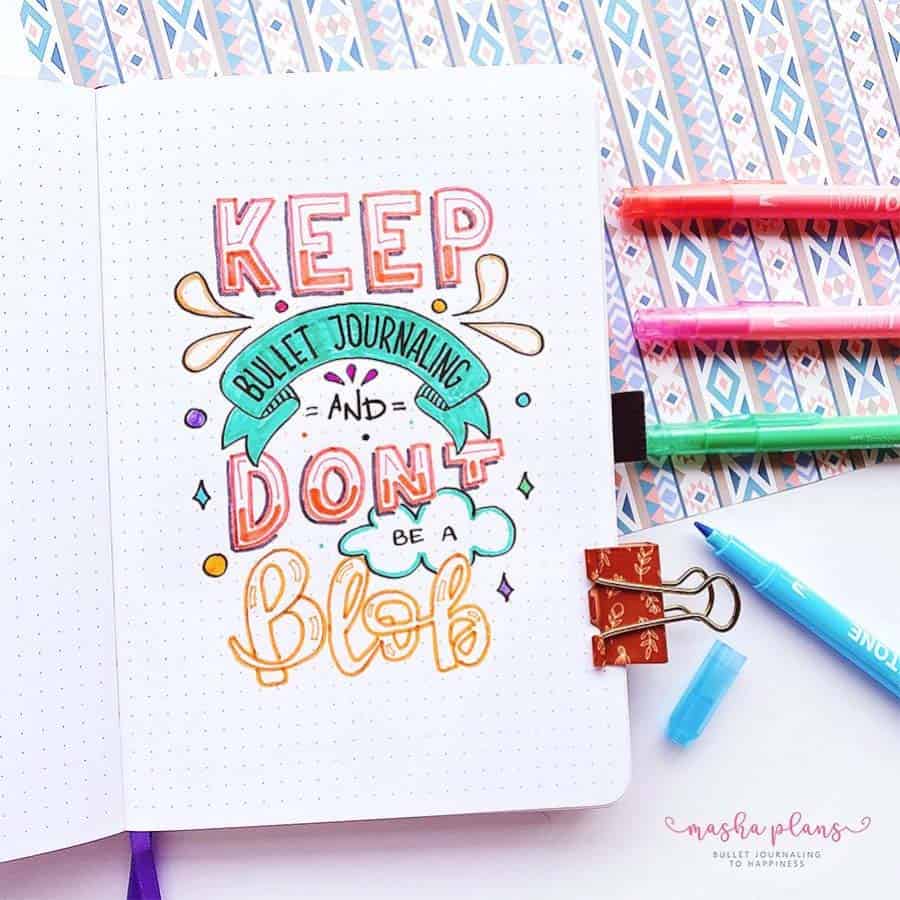
If you’re looking for hand-lettering supplies, I’d recommend Tombow Twin Tone markers (the ones I used for this page) or Crayola Super Tips (super affordable and come in 150 colors!).
If you want to dive into brush lettering, definitely go with Tombow Dual Brush Pens – they come in 100+ colors, they are the highest quality (I still have the set I bought in 2018), and they are easy to use even for beginners.
Structured Layout
A structured layout is built around a plan you decide on before you start writing, not one that reveals itself as you go. You choose the sections first, and every entry after that has to fit inside the shape you’ve already set — nothing free-flowing about it.
My cleaning tracker is the clearest example I have of this. It’s split into sections for daily, weekly, bi-weekly, monthly, bi-annual, and annual tasks, and next to each one is a small tracker so I can mark it off every time that chore actually gets done. I decided on those categories before I ever put pen to paper — the whole point of the layout is to hold them in place, spread after spread.
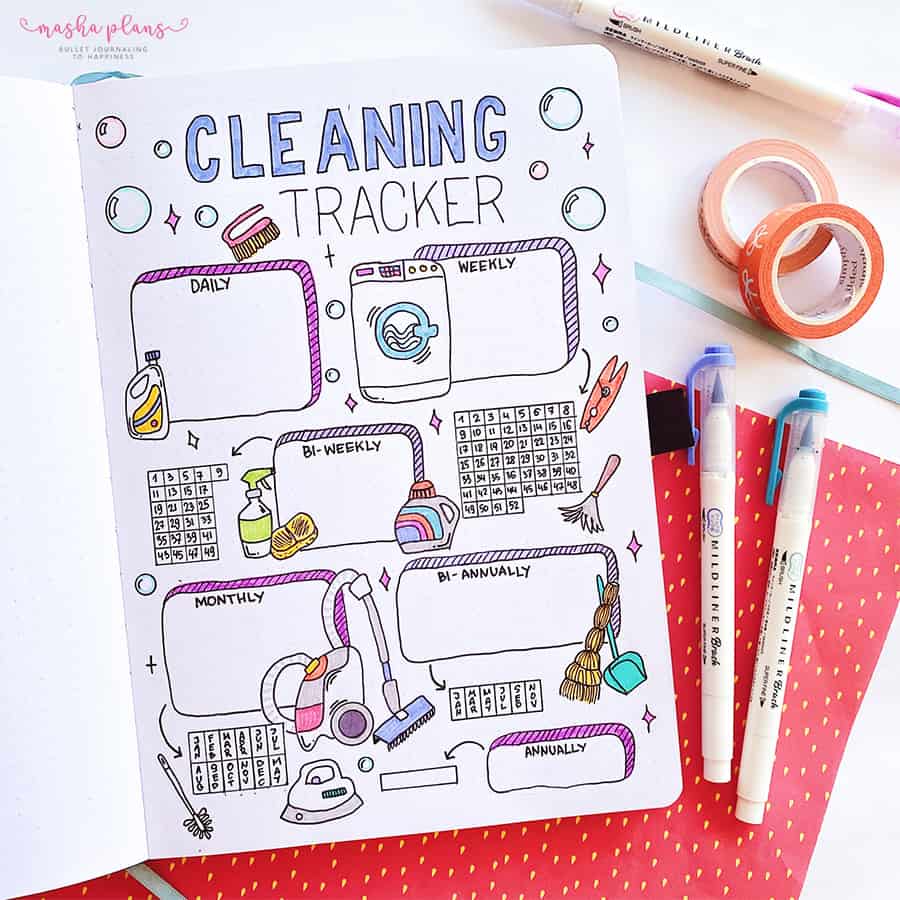
And yes, there is a mistake on this tracker, so be careful if you decide to recreate it. But anyways – this is a good example that even when you plan things out, you could mess up, and that’s ok – this is just how life is.
List
A list is the layout I’d hand to anyone who feels overwhelmed before they’ve even started. There’s no grid to plan, no categories to decide on — you just write your next entry underneath the last one, in the order things happen to hit you. Maybe you mark each new entry with a small dot or dash so your eye can find where one ends and the next begins, but that’s the only structure it needs.
As an example, I have a little self-care page. To be honest, once I finished the list, I came back later to add some doodles at the bottom. But it was my own artistic choice.
And it could be a fun idea – start with a simple list and later, if you ever feel like doing something creative, come back to your list and add some doodles.

In case you’re wondering, the colors I used on this spread, and pretty much all of the pages on this list, are Zebra Mildliners – they are my favorites in terms of colors, and you can see them pretty much on 90% of all my layouts.
Header Journal Ideas
A header-based layout puts all the weight on the header itself — it’s the most decorated, most eye-catching part of the page, more than the entry sitting underneath it. Think a boxed banner across the top, a burst of color, a hand-drawn frame or doodles around the title — something you’d notice before you’ve read a single word of what’s actually written.
The entry underneath stays simple on purpose. All the effort goes into the header, so it pulls your eye to the page and tells you what’s there before you’ve read anything.
This is the layout for entries you want to find fast by flipping through—the header does double duty as decoration and your fastest way back to that page.
As an example, here is my evening routine page. As you can see, the header and frame pull all the attention, and the routine itself is a simple set of words and steps.

Categorised Layout
A categorized layout divides the page — or the section — by topic instead of by date or order. Books in one block, quotes in another, recipes in a third, each with its own small heading so you know exactly where to add the next one.
It’s the layout version of organizing your whole commonplace journal by theme, just working at the level of a single spread instead of the whole notebook.
If you already know you have a few recurring obsessions — reading, cooking, a hobby you’re deep into — this layout saves you from hunting through pages later, since everything from that category lives in the same block. The tradeoff is that you need to decide your categories before you start filling the page, which requires more upfront thinking than most of these layouts do.
Another approach is to divide a certain theme into categories. For example, here is my self-care page, and as you can see, I thought of different categories I could benefit from, and then added those before filling out the page.
That way it’s much more organized and easier to navigate than just a lot of ideas written one after another.

There is no right layout.
None of these are rules — they’re just the commonplace book layout options that have actually earned a permanent spot in my own journal, depending on what I’m capturing that day.
Most people end up mixing two or three of them in the same notebook once they see what their own collecting habits actually look like.
Start with whichever one matches the last thing you wanted to write down, and let the rest sort itself out from there.
Free Printables
Not every layout has to be hand-drawn from scratch — some of these are easier to test with a printable template first.
In the Resources Vault, you’ll find 50+ free printables — trackers, lists, and pages you can print out and try in your commonplace book before committing to designing your own version.
If you don’t have access yet, sign up in the form below. Once you confirm your subscription, you’ll get the password to unlock 50+ free printables, stickers, and worksheets you can start using today.
More Resources
This is just the beginning when it comes to commonplace journaling; there is so much more to learn and try. So if you want to dive deeper into it, be sure to check out these posts next:
- What Is A Commonplace Journal? (And How To Start One From Scratch)
- 95 Commonplace Book Ideas: The Ultimate List To Fill Every Page
- Anime Journal Ideas: 9 Spreads I Actually Use
>>> What kind of layouts do you like using in your commonplace book? Share with us in the comments!
Hope this post was interesting. If you find it so, please share! If you enjoy my content and want to show your appreciation, please consider supporting me with a cup of coffee.
And remember: Keep Journaling, and Don’t Be A Blob!