
Study Bullet Journal: How To Set One Up And Actually Stick To It

Bullet journal page ideas for school can make homework, deadlines, and study habits feel manageable instead of overwhelming.
I’ve been Bullet Journaling since 2018, and I know how easily a planner gets abandoned by week three. To make this guide work in real life, I teamed up with Brighterly and their educational experts, combining my journaling experience with their experience teaching and helping students.
Here you’ll learn how to set up a study Bullet Journal, from a simple weekly spread to homework and habit trackers you’ll actually use, plus the small daily habits that keep you coming back to it.

I’ve been collecting study Bullet Journal ideas for a while now, and you’ll find a few of my other posts on the topic at the end of this one. But I’m not a student myself, and I know I could easily miss things or never think of them.
So I teamed up with Brighterly and their educational experts to put together one big, ultimate guide that covers every part of studying with a bullet journal.
I bring my Bullet Journaling experience, and they bring theirs from teaching and helping students. Together, we’ll go through how to set up your journal, which spreads are worth your time, and how to keep using it once the first week of motivation wears off.
This post may contain affiliate links. They will be of no extra expense for you, but I receive a small credit. Please see my Disclosure for more details. Thank you for supporting Masha Plans!
Why A Study Bullet Journal Works
Studying looks simple from the outside. You go to class, do the homework, and show up for the test. In real life, it’s a pile of small things that are really easy to lose: the worksheet due on Friday, the quiz that got moved, the chapter you meant to read before the lecture.
A Bullet Journal pulls all of it onto one page. And because you write it by hand, you actually have to look at it, which is half the battle.
I’m naturally disorganized, and my own study years were a mix of all-nighters and notes I couldn’t read afterward. I really wish I had known about Bullet Journaling back then.
Why Paper Still Helps When You Have A School Portal
Digital tools do one thing well: tell you what’s been assigned. Teachers can post a new task in seconds, and you can check deadlines whenever you like.
What a portal can’t do is tell you how long something will take, or which of three overlapping deadlines deserves your evening. That part is on you, and that’s where a paper weekly spread comes in. Use the portal to see what’s due. Use your journal to decide when you’ll do it.
Here’s what that looks like. Instead of writing only “History presentation: Friday,” you plan it backward:
- Monday: choose a topic
- Tuesday: find three sources
- Wednesday: make the slides
- Thursday: practice the presentation
- Friday: present
Add your regular homework to the same weekly spread, and by Tuesday you’ll see if the week is getting too heavy. That’s much better than finding out on Thursday night.
What A Study Bullet Journal Actually Looks Like
There’s no one correct layout, and that’s the beauty of it. Your pages should match how much you actually have on your plate.
Plus, actually, a lot of basic Bullet Journal pages work perfectly for school as well, just with a few little tweaks.
So, here are a few ideas on what you might want to include:
- Middle school: three simple sections are plenty: a weekly page for homework, a monthly page for tests and projects, and a small space for things to bring to school.
- High school: the same basics, plus a place for college application deadlines and notes from a tutor, if you have one.
- College: a semester overview, a deadlines page, and a weekly spread. Fewer reminders and bigger assignments mean you do more of the planning.
- Self-learners and adult students: one running list sorted by due date and a simple habit tracker can be all you need.
And if you only do three things, make them these: a future log, a weekly spread, and a homework tracker. Everything else can wait until you actually need it.
Like everything in Bullet Journaling, it’s about identifying what you personally need help with, then customizing pages to turn your notebook into a helpful study companion.
How To Set Up Your Study Bullet Journal, Step By Step
You don’t need much: a notebook you like (a dot grid one is great) and a pen you enjoy writing with.
My top choices are my Nuuna journal and a Muji pen. Plus, for a bit of color (perfect for headers and color coding), many people in the study journal community love Zebra Mildliners.
If you’re a student, you probably have your favorites, so gather your supplies and let’s create a journal that works for your school tasks.
Step 1: Start with a future log for term dates and deadlines
Use your future log for anything more than a couple of weeks away: exam dates, project deadlines, holidays, application dates. It gives you a bird’s-eye view of the term, so nothing sneaks up on you.

But a date alone isn’t a plan. “History project: October 16” tells you when it’s due, not when to start. So work backward from the deadline and give yourself checkpoints:
- October 5: choose a topic
- October 6: find sources and save useful materials
- October 8: finish research notes
- October 11: write the first draft
- October 13: edit and check your sources
- October 15: final read-through (this is your buffer day)
- October 16: submit
Now you have seven small dates instead of one big scary one waiting at the end. And that buffer day? Trust me, you’ll be glad it’s there.
Step 2: Make a weekly spread for homework and assignments
This is the page you’ll use the most. It shows what needs your attention over the next seven days.
A simple setup is to divide into five school-day sections. Here’s what a Monday could look like:
- Math: problems 12 to 24 (40 min)
- English: read pages 86 to 102 (35 min)
- Biology: finish the diagram (60 min)
- History: bring source notes (30 min)
The time estimates in brackets are the secret ingredient. Four tasks can look totally fine until you add them up and realize it’s nearly three hours. A weekly spread with estimates shows you that before the evening starts, so you can move something to Tuesday instead of panicking.

Here is an example of the weekly setup, and here I added a few extra sections that I think, as a student, you’ll find useful.
A list of priorities is basically a to-do list for the weekly studies – what subjects and what homework you have to finish this week.
There is enough space to add trackers, and here I added a sleep and a study tracker. The idea is to mark each day how many hours you slept or studied, so you can check whether you’re meeting your goals.
There is also enough space for a weekend section, because I don’t know about you, but I usually still have a bit of work (or study) to do on weekends.
Step 3: Keep a simple key for subjects and priorities
A key helps you read your pages at a glance. Start with the symbols you already know from Bullet Journaling and add only what you need:
- □ task
- ✓ finished
- → moved to another day
- ○ test or event
- ! urgent
Subject initials shorten entries: M for Math, E for English, S for Science, H for History. So when you see “! M: quiz review,” you instantly know it’s urgent and it’s math.
Keep the key small. If you have to check a separate page every time you see a symbol, it becomes harder to use than a plain task list.

Another small thing you can add to your key is color-coding your subjects. If you keep using the same colors, you’ll eventually learn to connect each color to a subject automatically, and that kind of visual memory is very helpful.
Personally, I experienced that with my mood trackers. I’ve used the same colors for my moods since 2020, and it helps so much to look at my mood tracker and understand how things are going from the start.
Study Bullet Journal Ideas To Track Homework, Deadlines, And Habits
The best study Bullet Journal ideas solve a real problem you have. Forget assignments? Track them by subject. Miss deadlines? Break big projects into smaller tasks. Can’t find regular study time? Track when you actually study.
Homework Tracker By Subject
Split your homework into columns so you can see what’s due and what’s still waiting:
| Subject | Task | Due | Status |
| Math | Fractions worksheet | Tue | ✓ |
| English | Read chapter 7 | Wed | □ |
| Science | Lab questions | Thu | □ |
| History | Presentation notes | Fri | □ |
Tutoring Session Tracker
If you work with a tutor, give those sessions their own little page. It connects what happened in the lesson to what you need to practice before the next one.
Reading is a good example. If your child (or you, as an adult learner) works with an online reading tutor like the ones at Brighterly, use the tracker to note the pages read, tricky words that came up, and one skill to practice before the next session. It works the same way for any subject, so here’s a layout with both:
| Date | Subject | What we covered | Practice before the next session |
| Sept. 9 | Reading | Main idea of chapter 3 | Reread pages 14 to 20, circle 5 new words |
| Sept. 10 | Algebra | Linear equations | Redo questions 4, 7, and 10 |
| Sept. 12 | Reading | New vocabulary | Use each new word in a sentence |
Then copy the “practice” items onto your weekly spread, so tutoring homework sits next to everything else you have to do that week.
Assignment Due-date Tracker
Essays, presentations, and research projects need their own tracker, because they’re too big to live as one line on your to-do list.
“Write a literature essay” gives you no clear starting point. Break it into smaller actions instead:
- Choose a topic
- Find three useful quotations
- Write the main argument
- Draft the first body paragraph
- Finish the draft
- Check citations
- Submit the final version
Give each step its own date. This also makes delays easy to spot: if you still haven’t chosen the topic two days after you planned to start, you can adjust the schedule now, long before the final deadline becomes a problem.
Habit Tracker For Daily Study Time
Don’t try to control everything at once. Pick one or two small study habits, like reading for 20 minutes every day, and see if you can really stick to them. You don’t need to track ten things.
And here’s the useful part: if you keep skipping the same day, don’t just move on to the next box. Ask why that day isn’t working and move the habit. If you always skip reading on Friday, you probably just have too much going on that day.

A Few Extra Pages For When You’re Ready
Once your basics are working, it’s worth a look at two more pages. An exam countdown makes the date visible so you can plan your prep.
It also creates a bit of excitement, especially if you add some kind of reward for yourself when the exams are done.
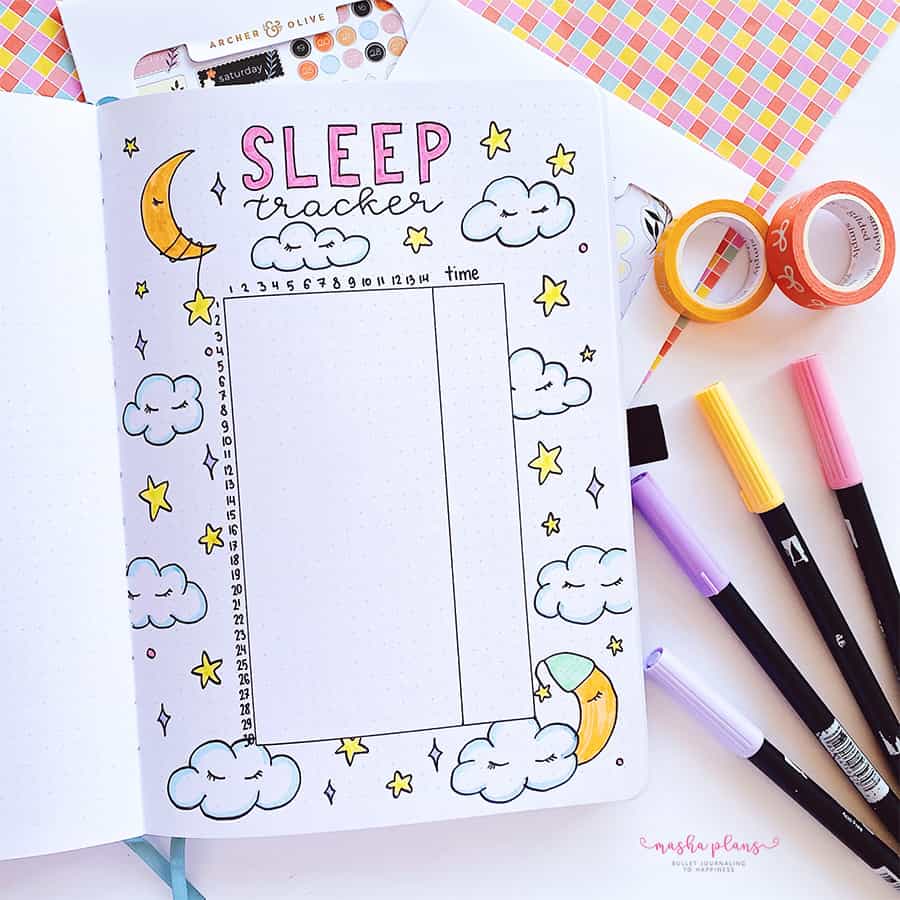
And a sleep tracker isn’t exactly a school page, but trust me: a tired brain remembers a lot less.
A sleep tracker can help you stay well-rested and build a sleep schedule you can maintain to keep you at your best.
Building A Study Bullet Journal Schedule
A good study schedule reflects the time you actually have, not the time you wish you had.
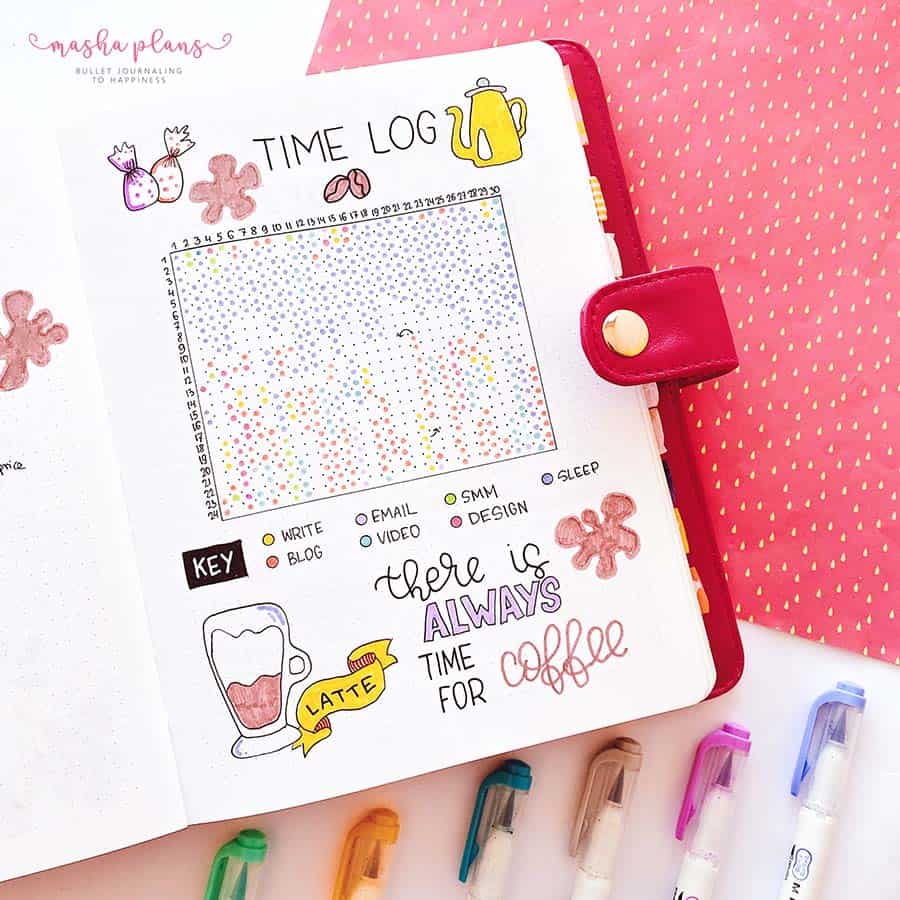
Start by writing down your fixed commitments: classes, work, sports, clubs, appointments, meals, and travel. Whatever is left is your real time for homework and studying. A time log can also show where your hours really go.
Time-blocking for Exam Weeks
Exam weeks mean preparing for several subjects at once. Instead of giving your whole evening to one subject, split the time. Say you have 90 minutes on Monday:
- 30 min: Biology
- 30 min: Math
- 30 min: English
This way you move forward on everything, even on a busy day. It also stops you from putting off the subject you like least. If you always think “I’ll do math later,” make it your first block. Then it won’t get the last 20 minutes of the day, when you’re already tired.
This is a good idea to include in your weekly spreads, so you can schedule study blocks for each day.

To be clear, this is the image I rendered, but it is based on a printable weekly spread I designed, and I wanted to show a clear example of how to use it for studying.
Balancing Multiple Subjects In One Spread
Not all subjects need equal time. Decide your priorities first, and only then fill in the days. A quick way is to decide how many study sessions each subject gets this week:
- Math: 3 sessions
- Biology: 2 sessions
- English: 2 sessions
- History: 1 session
Then place those sessions on specific days. If you have a math exam tomorrow, math gets the extra attention. A small history assignment due next week needs one session, not five.
This approach also tells you if you’ve planned too much. If you’re trying to squeeze ten sessions into three evenings, it’s clear the plan needs simplifying.
Reviewing And Adjusting Your Schedule Weekly
At the end of the week, take five minutes to look at what didn’t go to plan. Say chemistry was scheduled for 9 pm and it got postponed twice. Why? Most likely, by 9 pm your brain is done. So next week, move chemistry earlier and keep something lighter for the evening.
Ask yourself:
- What took longer than I expected?
- Which assignments did I miss?
- What time of day did I actually study well?
Use the answers to build a better week next time. Your schedule should get a little more realistic every week.
Study Bullet Journal For High School, College, And Adult Learners
Planning changes as the workload grows. A middle schooler might track individual worksheets, while a high school or college student juggles research papers, long reading lists, exam prep, and several deadlines at once.
- What changes in college
College courses often come with fewer daily reminders and more long-term assignments. A single line like “Psychology paper: October 30” leaves way too much work for the last few days. Here’s how it could look broken down:
- October 12: choose a research question
- October 14: find five academic sources
- October 19: finish notes
- October 21: write the outline
- October 26: complete the draft
- October 28: edit citations
- October 30: submit
Reading-heavy courses work with the same method. Instead of one giant “read the book,” split it by day: Tuesday pages 41 to 60, Wednesday pages 61 to 78, Thursday write your chapter notes. You can see the work for each day instead of being scared by the whole thing.
- If you’re a parent helping with homework
Start by making sure you both understand what needs to be done and what the final result should look like. Then sit down together once a week, ideally on Sunday, and let your child fill in the weekly spread. A few questions can guide it: What’s due? What’s the biggest thing this week? When will you do it?
For a big project like a history presentation, write down four or five steps so the task feels manageable and your child has a clear point of reference. If they have a tutor, add those practice tasks to the same weekly page.
- If you’re learning just for yourself
No exams? The same pages still work. A running list of topics, one habit tracker for your daily study time, and a weekly review are enough to keep a language, a course, or a new hobby moving forward.
How To Actually Stick To Your Study Bullet Journal
Here’s the honest part. The hardest bit of a study Bullet Journal isn’t setting it up; it’s still using it three weeks later. These are the things that make the difference.
- Don’t spend more time decorating than studying
I love a pretty spread as much as anyone, but decorating can quietly take over the planning. If you spend 45 minutes drawing a weekly page that takes five minutes to fill in, you’re not saving time. Write the essentials first: dates, deadlines, homework, and study blocks. Add the colors, stickers, and doodles afterward, if you have time.
During a busy exam week, a plain page with seven boxes may be all you need. And that’s perfectly fine.
- Check your journal in small moments
Writing down a deadline on Monday and opening your journal on Friday won’t help you at all. A journal only works when you look at it. Three quick check-ins are enough:
- In the morning: see what needs to happen today
- After school or work: check your homework and planned study time
- In the evening: move unfinished tasks to a more realistic time
Then, once a week (Sunday works well), look at the whole week ahead and change anything that doesn’t seem realistic.
- Tie it to something you already do
Keep your journal next to your coffee, on your desk where you do homework, or on top of your bag. The easier it is to grab, the more often you’ll open it.
- When you fall behind, don’t start over
Missed a few days? Don’t rip out the pages or start a fresh notebook. Use the → symbol to move unfinished tasks forward, cross out what’s no longer relevant, and carry on from today. A messy page you actually use beats a perfect page you’ve abandoned.
- Keep the system small
If your journal starts to feel like extra homework, simplify. Fewer symbols, fewer trackers, fewer pages. The most useful setup is one you can update in a few minutes and check daily.
A study Bullet Journal gives you one practical place for homework, deadlines, study time, and tutoring. Start with a weekly spread and add pages only when you actually need them. Break big projects into small steps, give the important tasks specific dates, and review your journal regularly.
A big thank you to Brighterly and their educational experts for teaming up with me on this guide. Their experience with teaching and helping students made it a much more complete resource than I could have written alone.
Free Study Journal Printables
Want to try these pages without setting them up from scratch? I have free study printables waiting for you in the Resources Vault, including a study plan, a study tracker, a school calendar, a course outline, and a semester overview.
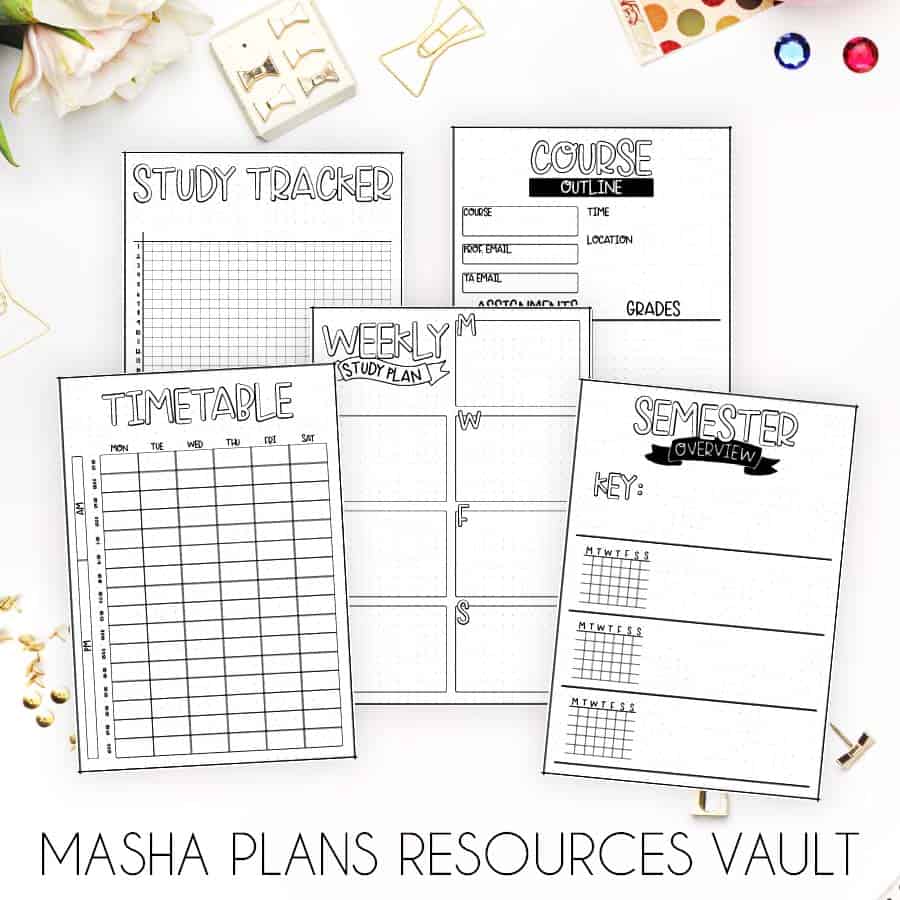
If you don’t have access yet, you can always sign up in the form below.
Once you confirm your subscription, you’ll get the password to get 50+ free Bullet Journal printables, stickers, and worksheets to use right away.
If you’ve never used printables before, be sure to check my post How To Use Printables In Your Bullet Journal.
It’s pretty basic, and you can find all the supplies you need in my post Supplies For Using Bullet Journal Printables.
More Study Bullet Journal Resources
Looking for more ideas? I’ve got you covered. Check out these posts next:
- 17 Must Have Bullet Journal Pages For School
- 11 Genius School Bullet Journal Ideas You Need to Try
- Study Stationery Finds For Curious Minds (Not Just Students)
>>> What’s the one page you can’t study without? Share with us in the comments!
Hope this post was interesting. If you find it so, please share! If you enjoy my content and want to show your appreciation, please consider supporting me with a cup of coffee.
And remember: Keep Journaling, and Don’t Be A Blob!